Introduction to Great Core Exercises

GREAT CORE EXERCISES. When people talk about the core, they often picture the superficial abdominal muscles that create a “six-pack” appearance. This common view is a simplification of a complex anatomical structure that acts as the body’s central powerhouse. Your core is more accurately defined as a 360-degree muscular cylinder that encompasses your entire midsection, extending far beyond the visible abs. This structure includes all the muscles that attach to the spine, pelvis, and rib cage, forming a stable base for almost every movement the body performs. It is designed primarily for controlling the position and motion of the trunk to maintain health and efficiency.
Your Core Exercise Muscles
GREAT CORE EXERCISES. Your core is composed of 29 muscles! They all work together to help protect your spine. Here, your core is the centre of your universe. Also, not only does your core help you prevent injury. But it also allows you to transfer force from your lower body to your upper body (and vice versa). Consequently, in all directions, it is responsible for giving you strength and stability when bending or twisting.
Benefits of Core Exercises

GREAT CORE EXERCISES. The benefits of core training go far and wide. However, if we had to choose only one type of training (thankfully we don’t!), it would be core training. Because it’s the key to longevity and a well-functioning body.
Here are the primary benefits of core strength training:
- Aids in injury prevention. It’s not just great for reducing the risk of spinal injuries. But core training is also great for the other joints in our body with poor core strength. Here, you have bad balance, and bad balance leads to pressure on the hips, knees, and ankles.
- Helps you create the proper distribution of weight, and aids in the absorption of force and the transfer of forces.
- Improves athletic performance. Not only does core training make you stronger, more explosive, and more powerful, but it also improves your balance. Also, coordination, agility and speed. So then, your core transfers power and energy to and from your legs and arms.
- It makes you stronger both rotationally and anti-rotationally. Thus, rotational force comes from your core, so when you twist, turn, swing, accelerate, decelerate, and move in multiple directions. Consequently, you will do so forcefully if you have a strong core. Moreover, you will be able to do these things safely because on the flip side. you have anti-rotation strength. Which helps you prevent injuries, stand strong, and remain balanced. Ultimately, Rotational and anti-rotational strength go hand-in-hand…but we will say we place more importance on anti-rotation.
Improves Posture
- Improves posture both when the body is still and in motion.
- Helps achieve your fitness goals as a stronger core leads to a more powerful squat, deadlift, bench press, military press, etc. As a result, core training will allow you to build more muscle in other areas of your body.
- Core stabilization exercises are an effective way to manage low back pain for those with chronic low back pain. Also, on top of all that, a strong core looks great!
- Core muscles a5re essential for good stability and if strong will help prevent falls.
Alternating Heel Touches
GREAT CORE EXERCISES. This is a great beginner exercise for targeting the obliques. It’s also a good one to add to a core circuit workout for any fitness level.
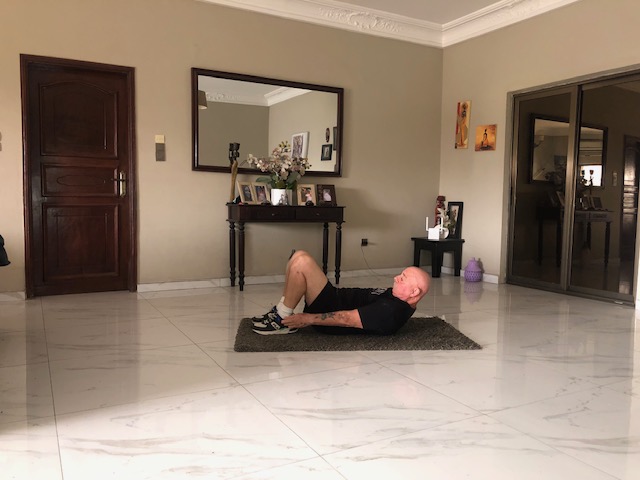
Muscles Worked: Internal Obliques, External Obliques, Rectus Abdominis.
How To Do It.
- Lie down on the floor face up.
- Your feet should be flat on the floor, shoulder-width apart, and heels aligned with the front of your knees.
- Arms by your side, core tight and your low back to the floor at all times, lift and keep your shoulder blades off the floor.
- From there, touch the side of your left heel with your left hand, come back, and then alternate sides back and forth. Your core should be tight at all times as well as your shoulder blades off the floor.
- Touch your heels 10 times on each side as 1 set.
- Try to do 3 sets or whatever you can manage.
Windshield Wipers
GREAT CORE EXERCISES. Here is a great core stabilization exercise. This one involves rotation
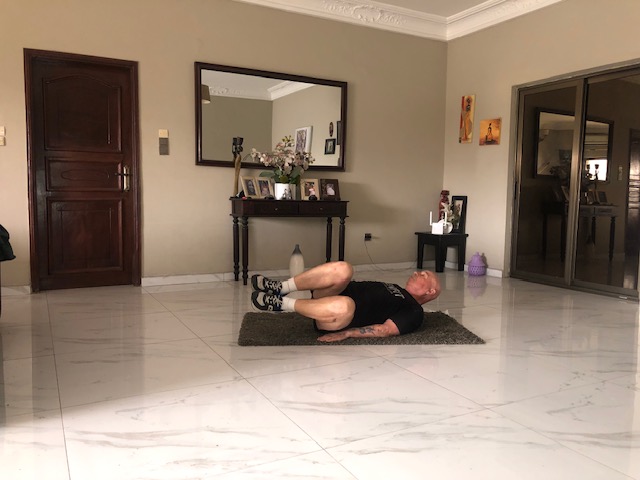
Muscles Worked: Internal Obliques, External Obliques and Rectus Abdominis
How To Do It.
- Lie down on your back.
- Bring your arms straight out to your sides.
- Bring your legs straight up so your body forms a 90-degree angle (bend your knees to make it easier).
- Rotate your hips to the left (do not let them touch the floor), then rotate to the right. Move slowly, keep your core tight, and be in control at all times.
- Do this 10 times on each side as 1 set.
- Try to do 3 sets or whatever you can manage.
Lying Knee Raise
GREAT CORE EXERCISES. This is one of the tougher core exercises
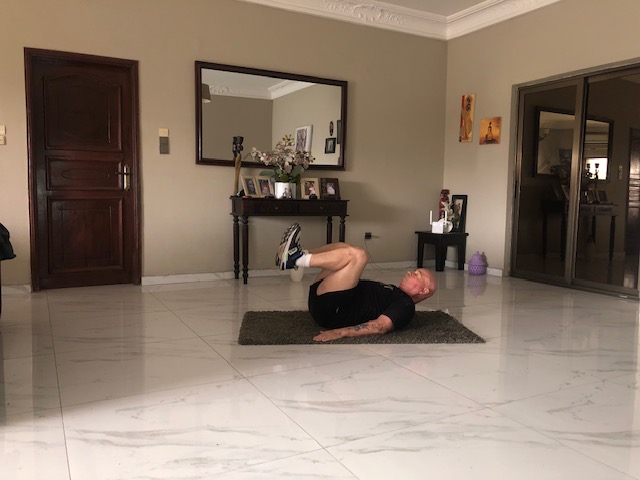
Muscles Worked: Rectus Abdominis, Transverse Abdominis, Hip Flexors.
How To Do It.
- Lie down face up with your legs extended together and your arms at your side palms down (place your hands under your butt to make it easier).
- Bring your legs in until your knees are past your belly button (your legs should be at about 90 degrees), then slowly bring them back to fully extended.
- Keep your feet together and don’t let your feet rest on the floor during the entire set.
- Repeat 10 times as 1 set.
- Try to do 3 sets or whatever you can manage.
Mountain Climbers
GREAT CORE EXERCISES. Mountain climbers are a great core exercise as they work the core muscles while also pumping your heart rate up. It’s a double whammy. Burn fat and strengthen your core. Moreover, they work many muscles from your quads up to your shoulders!
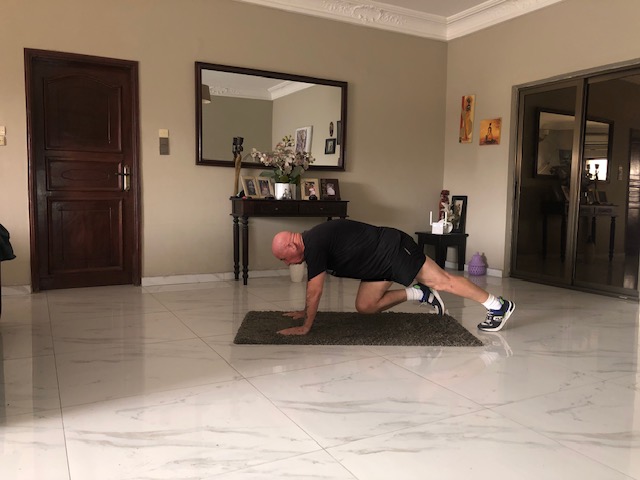
Muscles Worked: Hip Flexors, Rectus Abdominis, Erector Spinae, Quadratus Lumborum, Multifidus, Glutes, Quads, Hamstrings, Shoulders, Triceps.
How To Do It.
- Get into a standard plank position with your hands on the ground. And make sure your weight is distributed evenly between your hands and your toes. Hands should be shoulder-width apart and directly below your shoulders. Your abs should be engaged, your back flat, your neutral spine and the back of your head/neck aligned with your back.
- Bring your right knee towards your chest as far as you can go. Then as you return it, bring your left knee towards your chest.
- Continue alternating for 10 each knee as 1 set.
- Try to do 3 sets or whatever you can manage.
- To increase the intensity, speed up and do this as fast as you can (this is what’s great about mountain climbers, beginners can go slow and those who are advanced can go fast to equal core strengthening and fat-burning effect! It’s an exercise for all levels)
Video
Books by Ian on Amazon Kindle Publishing



These 3 books are a Series Designed to Advise on Personal Security to Keep you Safe
1 ASIN: B0GTMWXH8B 2 ASIN: B0GTMRP25L 3 ASIN: B0GTQ2W8DF
For your information, you can read these books on Amazon without buying them.
In Conclusion
Your core is the central part of your body. It includes your pelvis, lower back, hips and stomach. The stomach muscles sometimes are called abs. Core exercises train the muscles in your core to work in harmony. This leads to better balance and steadiness, also called stability. Stability is important whether you’re doing regular activities or any other things where your stability is a safety issue. So then, stability is a great aid in fall prevention. In fact, most sports and other physical activities depend on stable core muscles.
Important Note *
Remember that everyone is different, it is ultimately YOUR RESPONSIBILITY to find what your body responds to. So please do your due diligence before trying anything new, including getting Medical Advice to ensure your safety and peace of mind.
Connect with me and leave a comment or two on my